
The Construction Economist — July 25, 2026
Alphabet's Tuesday capex hike pushes the Big Four toward ~$725B for 2026 · Data centers become construction's largest commercial segment · The billings pipeline stays frozen at 47.3 — a 41-month low · Tariffs push the commodity index to a 2026 high · The 500,000-worker gap meets ICE · Bouygues buys
Alphabet's Tuesday capex hike pushes the Big Four toward ~$725B for 2026 · Data centers become construction's largest commercial segment · The billings pipeline stays frozen at 47.3 — a 41-month low · Tariffs push the commodity index to a 2026 high · The 500,000-worker gap meets ICE · Bouygues buys its way into the U.S. Southeast
Top News
The Hyperscaler Build-Out Hits ~$725B: Alphabet's Capex Hike Caps a Record Year of AI Spending Company filings / ConstructConnect · ~4 min read
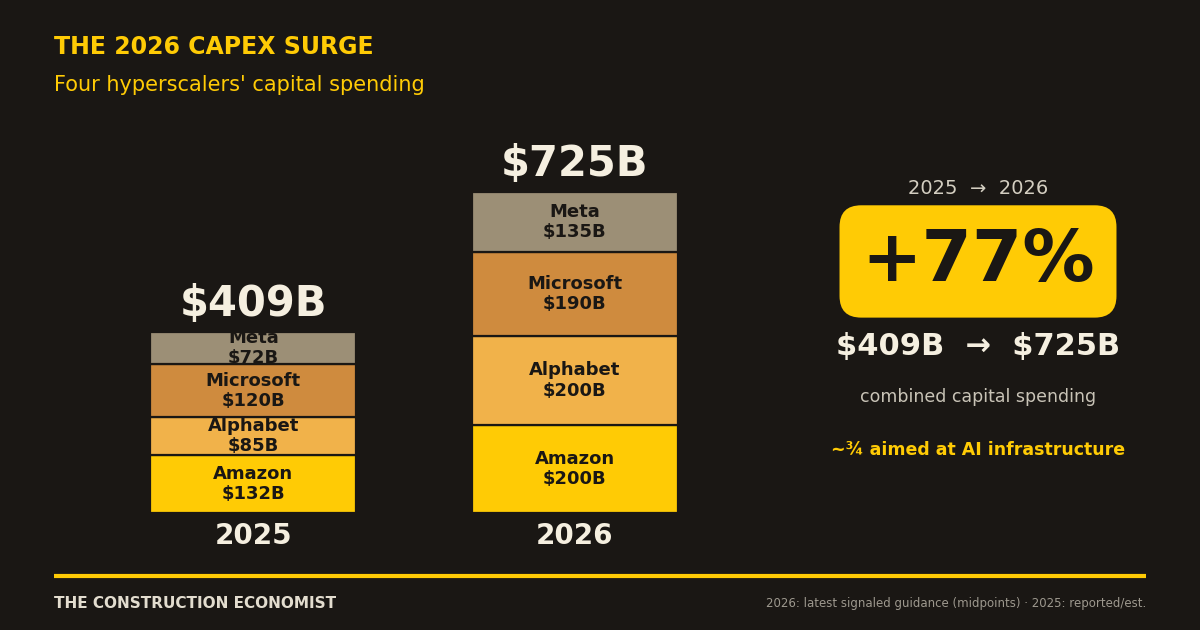
Alphabet raised its 2026 capital-spending guidance to $195–205 billion on its July 22 earnings call — up from $180–190 billion a quarter earlier — the latest and largest step in a spending race that now has the four biggest hyperscalers guiding toward roughly $725 billion of combined 2026 capex, about 77% above 2025. Alphabet's raise (Q2 capex alone was $44.9 billion) joins Amazon's ~$200 billion plan (up from $131.8 billion in 2025), Microsoft's ~$190 billion (lifted by $25 billion for rising component costs), and Meta's $125–145 billion — with roughly three-quarters of the total aimed at AI infrastructure. On the ground that capital is landing as concrete: data-center construction is now running at a $51 billion seasonally adjusted annual rate — the single largest segment of U.S. commercial building, past office — and year-to-date data-center spend of $58.1 billion is more than four times the record pace set over the same months of 2025.
What it means: one buyer class — four companies — is now setting the demand curve for U.S. nonresidential construction, and this week they raised the bar again. That's a gift and a risk. The gift: it's the main reason headline nonresidential starts are up 18% year to date while almost every other private segment shrinks. The risk: concentration. When a handful of tech balance sheets fund the segment holding up the sector's numbers, their capex-cycle turns — component-cost swings, a pause on ROI questions, or a single moratorium (as New York imposed last week) — transmit straight into contractor backlogs. For firms riding the wave: price the cyclicality, keep the electrical/mechanical crews the data-center trades are bidding up, and don't extrapolate the $725B line as if it were infrastructure spending that reprices slowly. See the feature graphic for the 2025→2026 breakdown by company.
Architecture Billings Stay Negative at 47.3 — the Downturn Now Runs 41 Months American Institute of Architects / Deltek · ~3 min read
The AIA/Deltek Architecture Billings Index registered 47.3 in June, the AIA reported July 22 — up nearly three points from May but still under the 50 mark that separates growth from contraction. Newly signed design contracts sat just below 50 (essentially flat), while backlogs slipped to an average 6.3 months from 6.6 in the first quarter. The ABI has now gone 41 consecutive months without a majority of firms reporting billings growth — the longest stretch in the index's 30-plus-year history.
What it means: the ABI leads nonresidential spending by roughly nine to twelve months, so June's reading is a window into mid-2027 — and it's dim. Set against the capex story above, the two Top News items frame the whole issue: mega-project starts are booming now, but the broad design pipeline that feeds 2027 keeps contracting. Budget the out-years off the 47.3, not the 18%.
Materials & Supply Chain
Commodity Index Hits a 2026 High as Tariffs Lift Steel, Lumber and Finishes RoMac Building Supply Whole House Commodity Report · ~3 min read
The RoMac Whole House Commodity Index rose 1.8% in July to $55,287, a second straight monthly increase and the highest level of the year. Gains ran across structural lumber, engineered wood, roofing, steel and interior finishes, with Southern Pine 2x12 up 10.7% and 2x6 up 7.5% on the month. Hot-rolled coil steel sat near $1,002 per ton and structural steel near $2,519 per ton, and Canadian softwood lumber now carries a combined tariff burden of roughly 35.9%, including the Section 232 duty. The report ties the move to tariffs, mill closures and shifting log-export patterns rather than a surge in demand.
AGC Urges Contractors to Rewrite Contracts as Tariff Costs Bite Associated General Contractors / Construction Owners · ~3 min read
With new duties of up to 50% reshaping steel and copper costs and tighter domestic mill capacity compounding the pressure, the Associated General Contractors is advising members to update contract language now — price-escalation clauses, material-cost pass-throughs and delay provisions — rather than absorb tariff swings mid-project.
What it means: this is cost-push, not demand-pull. Prices are rising because supply is being taxed and constrained, not because buyers are competing for material — which is why the actionable lever is contractual, not a volume forecast. Estimators should escalate off the input trend and treat the AGC guidance as the week's operational takeaway.
Project Finance & Economics
Construction Spending Edges Up 0.1% in May — but the Sector Is Running at Two Speeds Engineering News-Record / U.S. Census Bureau · ~3 min read
Total construction spending rose 0.1% in May to a $2,210.2 billion seasonally adjusted annual rate, the Census Bureau reported. Residential edged up 0.4% while nonresidential was essentially flat at $738.7 billion (down 0.3% from April), with declines in manufacturing (−1.4%), power (−0.2%) and commercial (−0.3%) offsetting small gains in office, educational and highway work. Beneath the flat headline the divergence is stark: warehouse spending has fallen three straight months and is down 8.5% year over year, and the office category is down 11.9% since May 2025 — even as data-center and power work climbs.
AIA Releases July Consensus Construction Forecast American Institute of Architects · ~3 min read
The AIA's mid-year Consensus Construction Forecast — a panel of the major economic forecasters — offers a refreshed read on where nonresidential building spending lands through 2027. Paired with June's soft ABI, it is the cleanest available look-ahead for owners setting next year's capital plans.
Labor & Workforce
The Workforce Gap Meets Enforcement: ~500,000 Workers Short in 2026 Construction Owners · ~4 min read
The industry needs on the order of 500,000 additional workers in 2026 to meet demand, and more than half of the roughly 349,000 workers required this year are needed simply to replace retirees rather than to support growth. Intensifying immigration enforcement, including ICE raids on job sites, is tightening an already-thin labor pool at the same time.
Construction Wage Growth Runs Double the Broader Economy Randstad 2026 Salary Guide · ~3 min read
Construction wage growth is projected at 8–12% for 2026 — roughly twice the 3.5–4% pace across the wider U.S. economy — with specialized trades in high-demand markets seeing 9–11% increases. Union settlements are running at their strongest pace in over a decade.
What it means: labor scarcity has become a capital-allocation driver, not just an HR problem. When crews can't be hired and enforcement is thinning the pool, firms buy the workforce instead — the logic behind this week's M&A (below). The sharpest wage and poaching pressure sits in the electrical and mechanical trades feeding the data-center build-out.
People & Firms
Bouygues Construction Acquires Vannoy Construction, Entering the U.S. Southeast Bouygues Construction / Yahoo Finance · ~3 min read
French major Bouygues Construction closed its acquisition of Vannoy Construction on June 30 (announced July 2), a Charlotte, North Carolina–based general contractor, establishing a durable U.S. presence in one of the country's fastest-growing construction markets.
The 2026 M&A Thesis: Buyers Are Acquiring Crews and Backlog Construction Dive · ~3 min read
Deal activity in 2026 increasingly targets data-center and power-infrastructure contractors, with buyers prioritizing a skilled workforce and a committed project backlog over pure technical fit — using acquisition as a faster, more reliable path to labor capacity than organic hiring in a 500,000-worker-short market.
The Construction Economist — What's Moving Construction? The Economic Look-Ahead.